
Whole Genome Sequencing
Rapid whole genome sequencing returns actionable answers in days, helping clinicians make more informed treatment decisions.

Rapid whole genome sequencing is well documented in the critical-care literature. Here is what the published evidence shows about the modality.
Figures in this section are from the published rWGS literature, not Fulgent outcomes data.

~3 days
median time to diagnosis with rWGS1
1 in 3
critically ill infants get a change in management from the result1,2
< 5%
of eligible patients currently receive rWGS3
Used first-line, rWGS changes management in up to 87% of diagnosed babies4,a and saves up to $15,786 per child sequenced,1 largely by shortening hospital stays.
References
1. PMID 34089648 · 2. PMID 38440187 · 3. PMID 38413639 · 4. PMID 39999847 · 5. PMID 31246743 · 6. PMID 34211152 · 7. Rady Children’s Institute for Genomic Medicine, Payer Policy & Advocacy. radygenomics.org
a. The 87% (ref. 4) is among diagnosed newborns. The figure is roughly 41% for all newborns tested. Project Baby Bear (ref. 1) reports 32% of all infants tested with a major change in medical care.
What Fulgent brings to rapid whole genome sequencing, from turnaround to the breadth of a single test.
Standard workup
Takes weeks
Rapid WGS
Gets there in days
Rapid FulGenome
Preliminary report in as few as 2 days
An urgency progression, not a head-to-head comparison. The literature figure and the Rapid FulGenome turnaround describe different endpoints.
A single whole genome test can detect six variant classes at once, so you stop ordering sequentially.
Preliminary report in as few as 2 days: the most relevant pathogenic and likely pathogenic variants, so you can act while comprehensive review continues.
An optional add-on to help increase diagnostic yield and resolve variants of uncertain significance.
Reanalysis is included as part of your original test order, if the phenotype evolves (limitations apply).
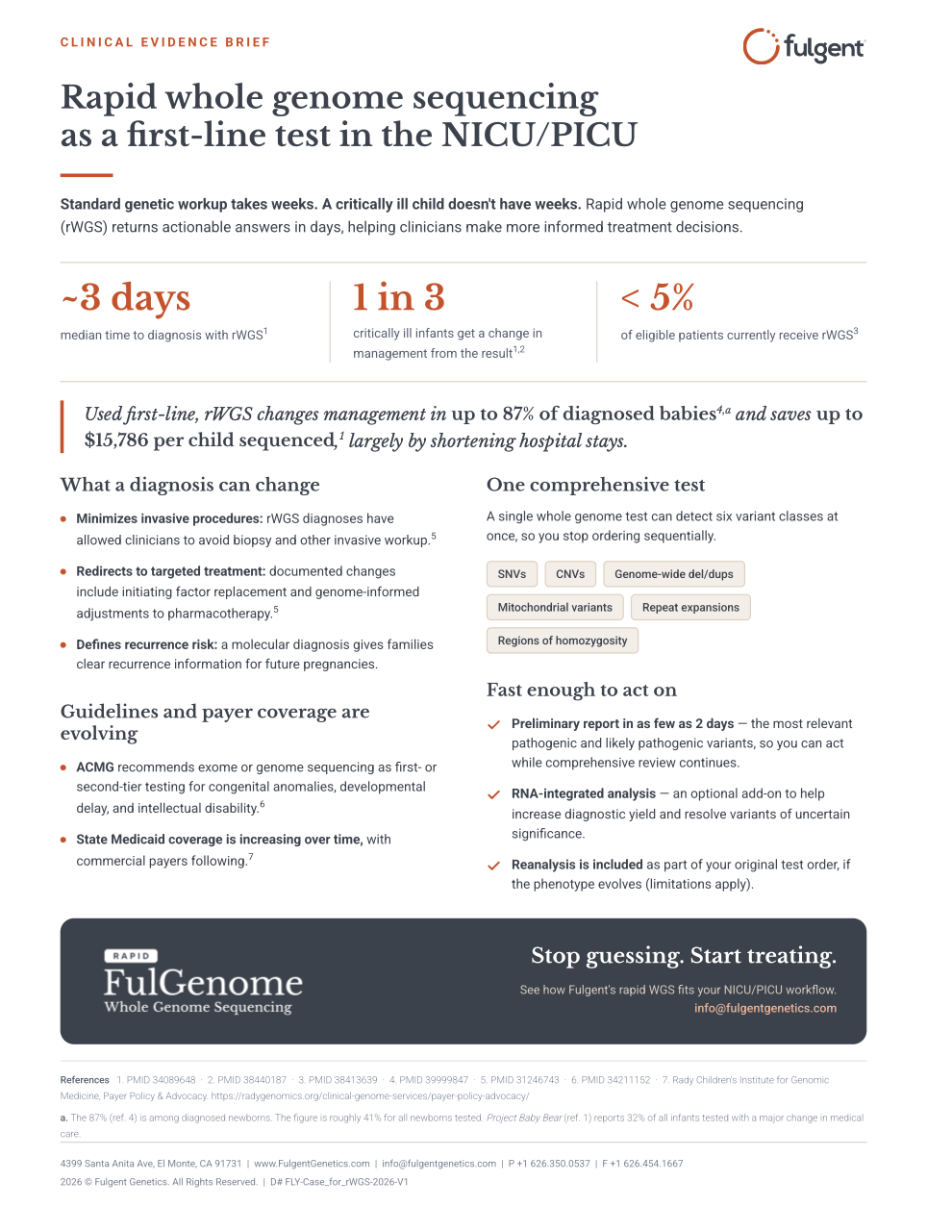
A clinical evidence brief a clinician champion can take to a NICU committee or medical director to make the case for adopting rapid whole genome sequencing.